


{{ secondMenu.name }}




With scheduled backup policy, virtual machines can be automatically backed up during specified period of time. 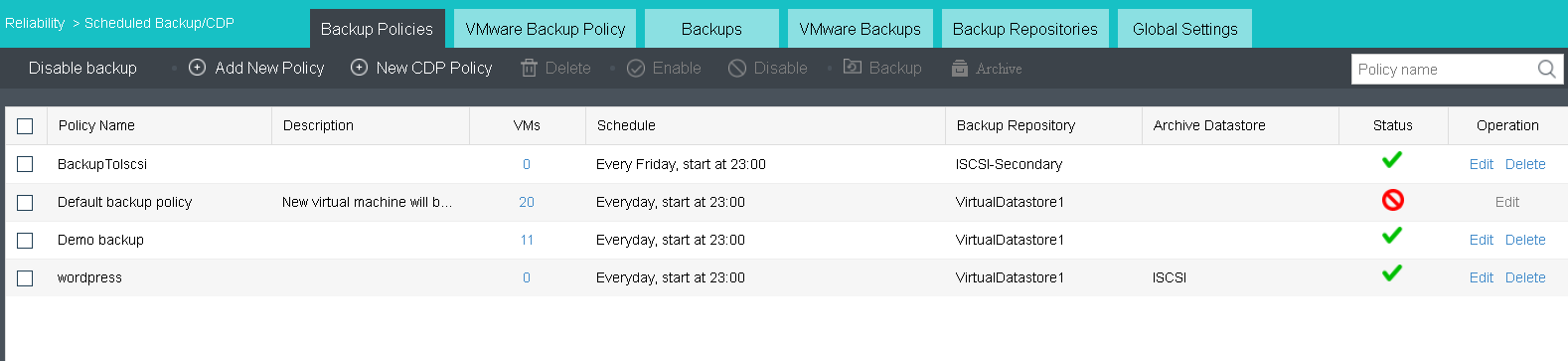
On the toolbar, there are Enable/Disable backup, New Backup Policy, New CDP Policy, Delete, Enable, Disable and Backup, as shown below: 
Enable/Disable backup: To enable or disable backup, click Enable backup to enable backup or Disable backup to disable backup.
New Backup Policy: To add a new backup policy, click New Backup Policy. For details, refer to 2.6.12.1.1 Adding New Backup Policy section.
To add a new CDP policy, click New CDP Policy. For details, refer to 2.6.12.1.2 Adding New CDP Policy section.
To delete backup policy, select the policy you want to delete and click Delete.
Enable: To enable a backup policy, click Enable, or click on the icon .
 To disable a backup policy, click Disable, or click on the icon
To manually execute a backup policy, select a policy and click Backup.
To archive the backup to another backup repository, select the policy and click on Archive.
To search for a backup policy, enter the policy name in the search box 
On the Backup Policy tab, it displays policy name, description, the number of virtual machines to be backed up, backup repository, backup period, status and operation, as shown below: 
Policy Name: Displays name of Sangfor backup policy.
Description: Displays descriptive information of Sangfor backup policy.
VM(s): Displays the number of virtual machines to be backed up. To view the virtual machines, click on the number under VM(s).
Backup Repository: Displays backup repository.
Schedule: Displays backup period.
Archive Datastore: Display the datastore to store the archive backup.
 Status: Displays status of the backup policy, enabled or disabled. To enable a backup policy, click on the icon. To disable backup policy, click on the icon.
Operation: To edit or delete a backup policy, click Edit or Delete under Operation. The default scheduled backup policy cannot be deleted.
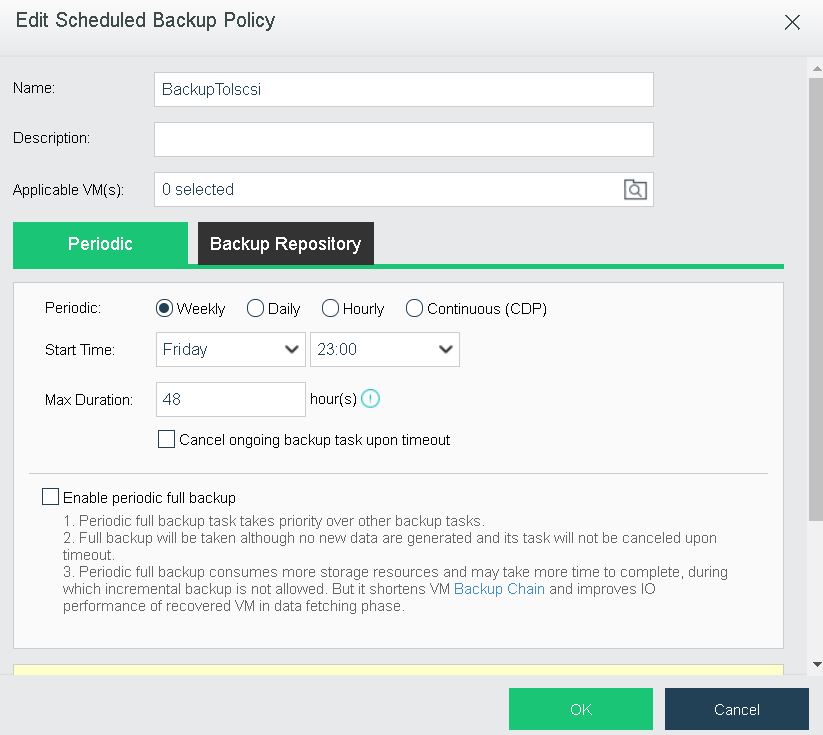
To edit a backup policy, click Edit and enter the following page:
To add a new backup policy, click New Backup Policy, and then follow the wizard to specify backup periodic, select virtual machine, specify backup repository and policy name, as shown below:
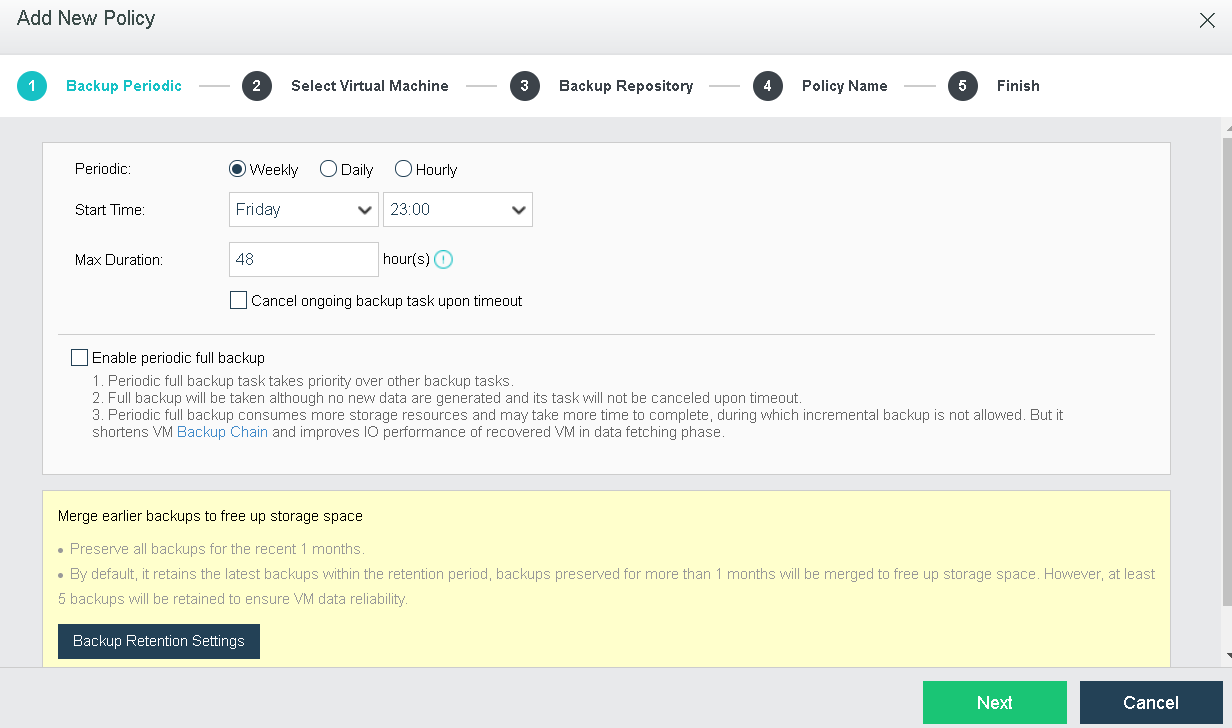
Backup periodic can be on weekly basis, daily basis and hourly basis. Automatic backup cleanup can be selected to have backups deleted automatically. 
Weekly: Select Weekly and configure as follows: 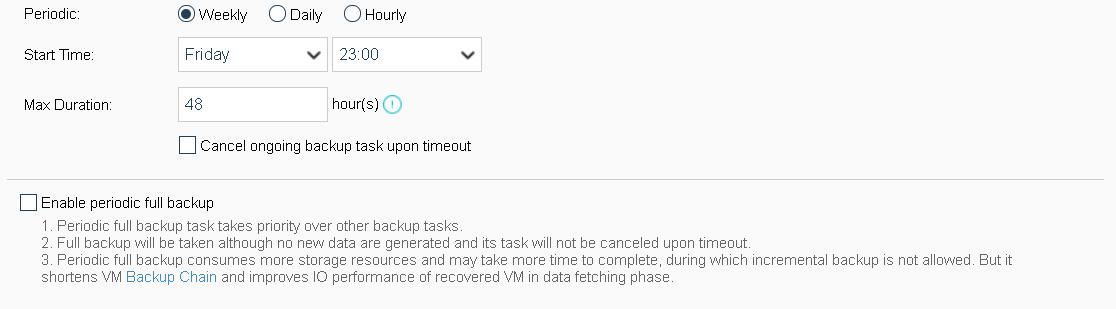
On weekly basis: Options are from Sunday to Saturday.
Start Time: It specifies time to start backup. Since backup may bring impacts to system service, select a period that service is not busy
Max Duration: It specifies the longest period that the backup operation can last. New backups only occur within this time range and will not stop once starts. However, the backup tasks having not started yet will resume when the time range arrives again. You may select Cancel ongoing backup task upon timeout based on your own needs.
Enable periodic full backup: Full backup will be created periodically on the specific time and date instead of only incremental backup created. 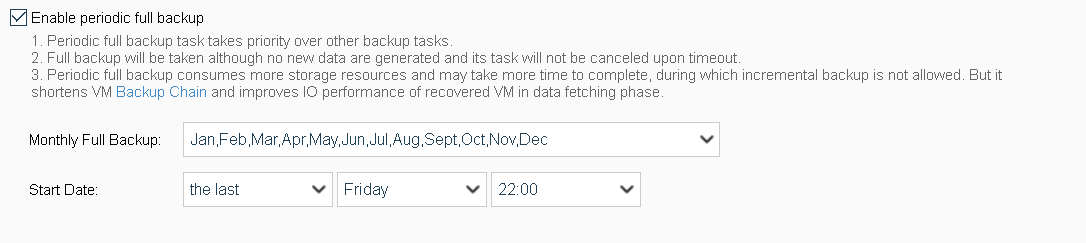
Backup Retention Setting: It specifies the longest period that backups will be kept. The longest period is three months. 
Daily: To have data backed up on daily basis, choose Daily for Periodic, as shown below: 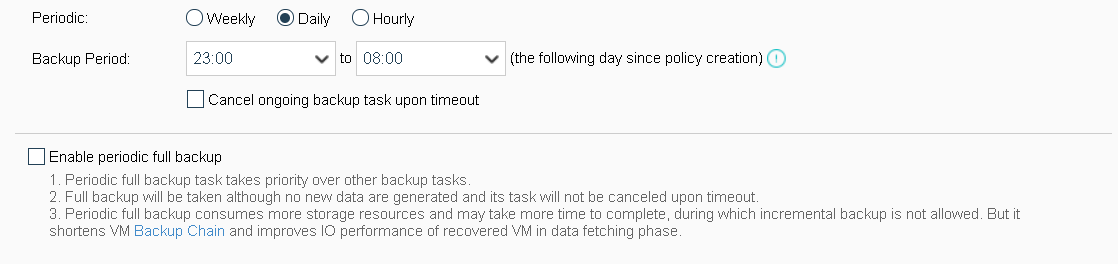
Backup Period: It specifies the longest period that the backup operation can last. New backups only occur within this time range and will not stop once starts. However, the backup tasks having not started yet will resume when the time range arrives again. You may select Cancel ongoing backup task upon timeout based on your own needs.
Enable periodic full backup: Full backup will be created periodically on the specific time and date instead of only incremental backup created.

You may enable Automatic backup cleanup to automatically preserve all the backups for the previous 3 days, one backup (the last one) for the earlier week and one backup for each of the even earlier weeks (the one created on Sunday only).
Hourly: To have data backed up on hourly basis, select Hourly as Periodic, as shown below: 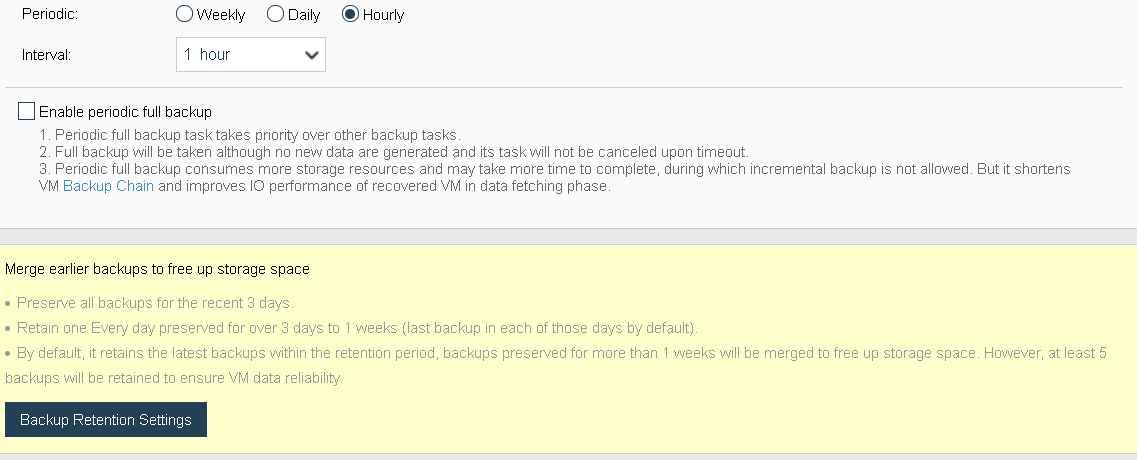
Interval: The minimum interval is 1 hour.
Enable periodic full backup: Full backup will be created periodically on the specific time and date instead of only incremental backup created.
Select the virtual machine(s) you want to back up. You may view the virtual machines by Group, Node, Datastore or select All to view all the virtual machines, or you may enter the name of the virtual machine in the search box to search for a specific virtual machine. Select virtual machines under Available and then the selected virtual machines will be added to the Selected list on the right, as shown below:
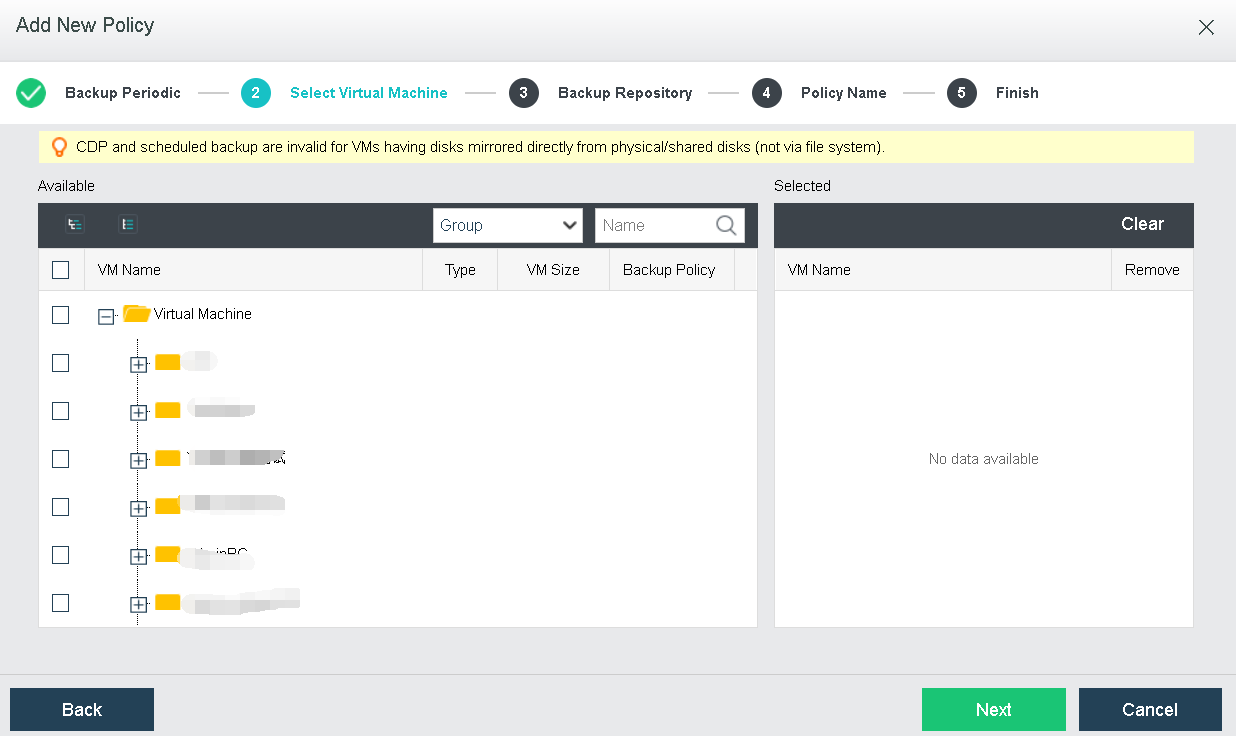
Clear: To clear the selected virtual machines, click ‘Clear’.
 To remove a virtual machine from the selected list, click
CDP or data protection is not applicable to virtual machines having disks mapped
directly from physical or shared disks, rather than via file system.
One virtual machine cannot be associated with more than one backup policy. If the
virtual machine is associated with a new policy, it will be removed from the previous policy.
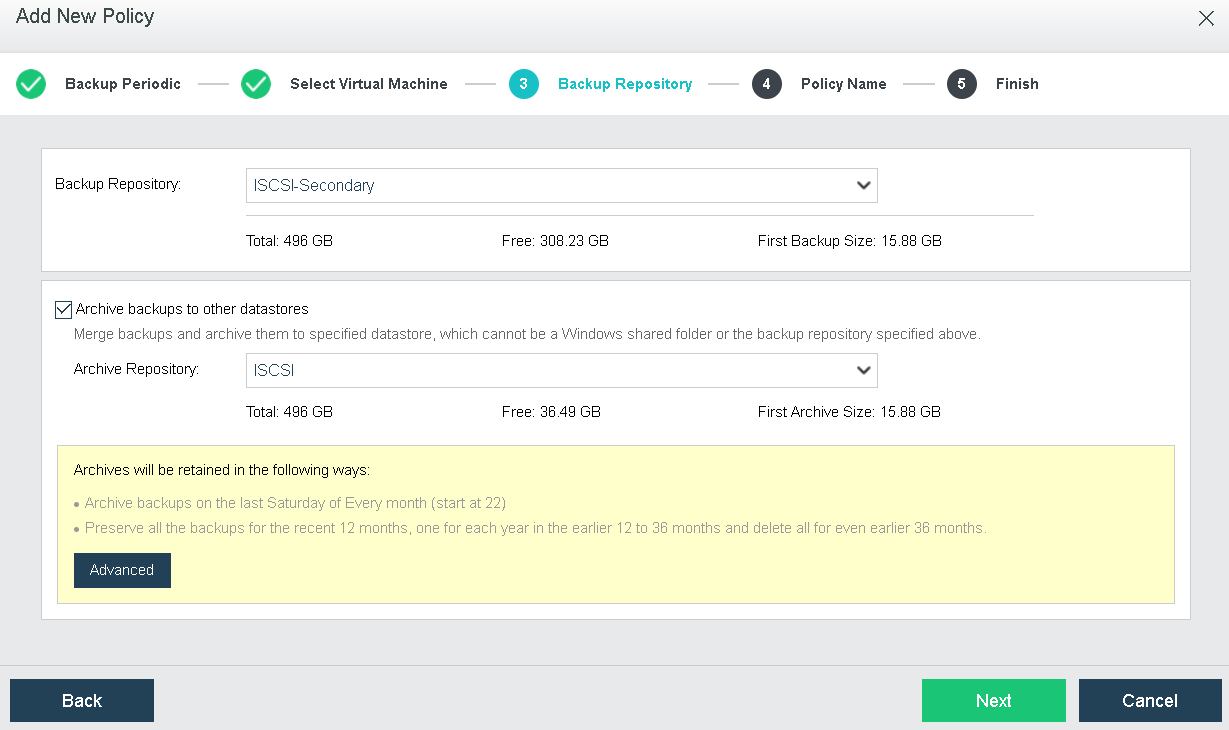
Backup Repository: It specifies backup repository, you may select an existing datastore or choose to add a new Windows shared folder. Once the backup repository is specified, total capacity, available backup repository size and first backup size of the selected data store will be displayed.
Archive backup to other datastore: Specifies a repository to store the archive backup.
Note that next backup will have all data backed up if backup repository is changed,
please operate with caution.
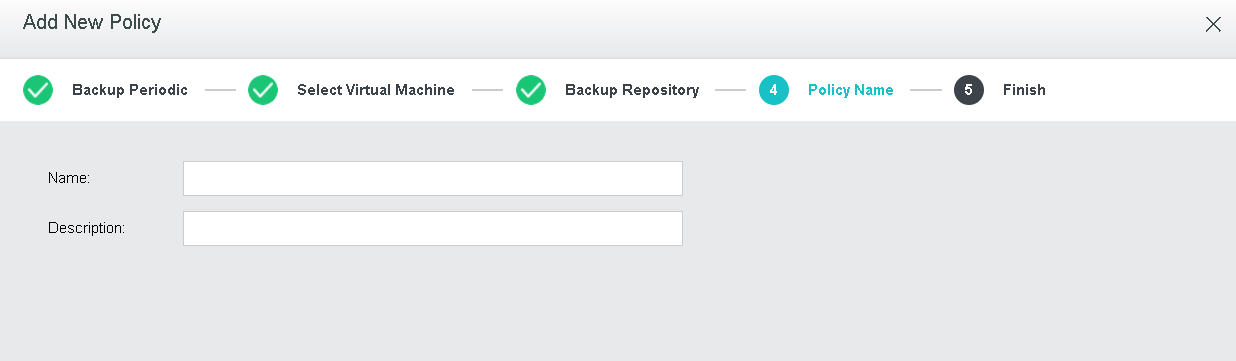
Name: Specifies name of the backup policy
Description: Specifies description of the new backup policy.
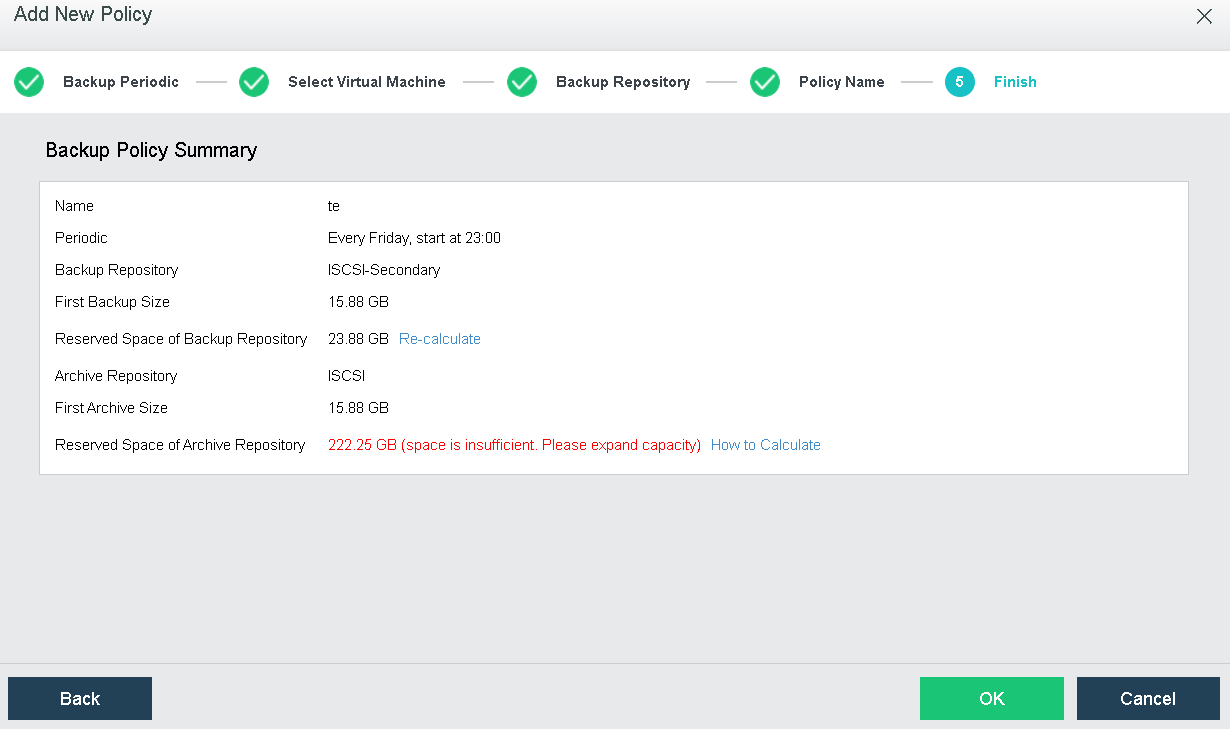
It displays basic settings of the backup policy, such as Name, Retention Period, Backup Repository and First Backup Size, as shown below:
To add a new CDP policy, click New CDP Policy to enter the following page and then follow the wizard to specify continuous backup period, select virtual machine(s) and backup repository, and specify policy name, as shown below: 
It involves the configurations of the following fields: IO Activity Logs Retention Period, Backup Periodic, Backup Retention Period. And Automatic backup cleanup is optional.
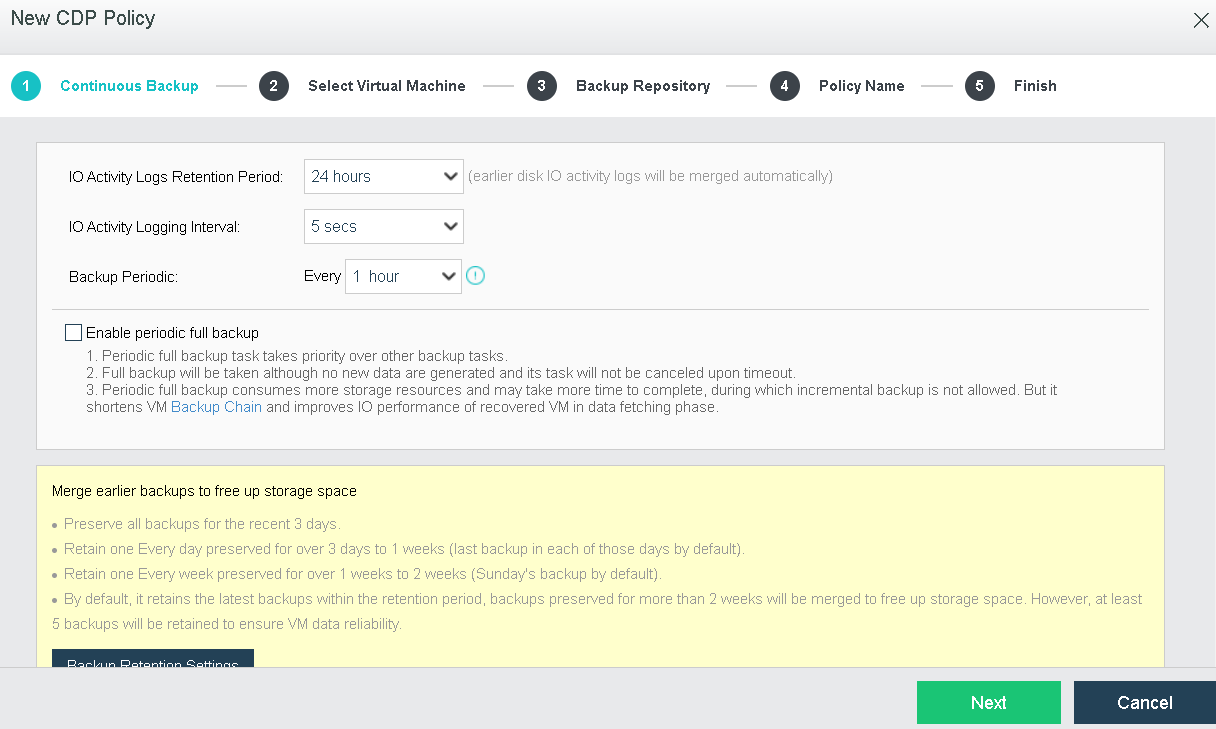
IO Activity Logs Retention Period: Specifies how long IO activity logs will be preserved. The longest period is 3 days. Earlier disk IO activity logs will be deleted automatically once the specified period is reached.
Backup Periodic: Specifies how often backup task is executed. The minimum backup periodic is one hour.
Retention Period: It specifies how long backups will be kept. The longest period is three months.
You may enable Automatic backup cleanup to automatically preserve all the backups for the previous 3 days, one backup (the last one) for the earlier week and one backup for each of the even earlier weeks (the one created on Sunday only).
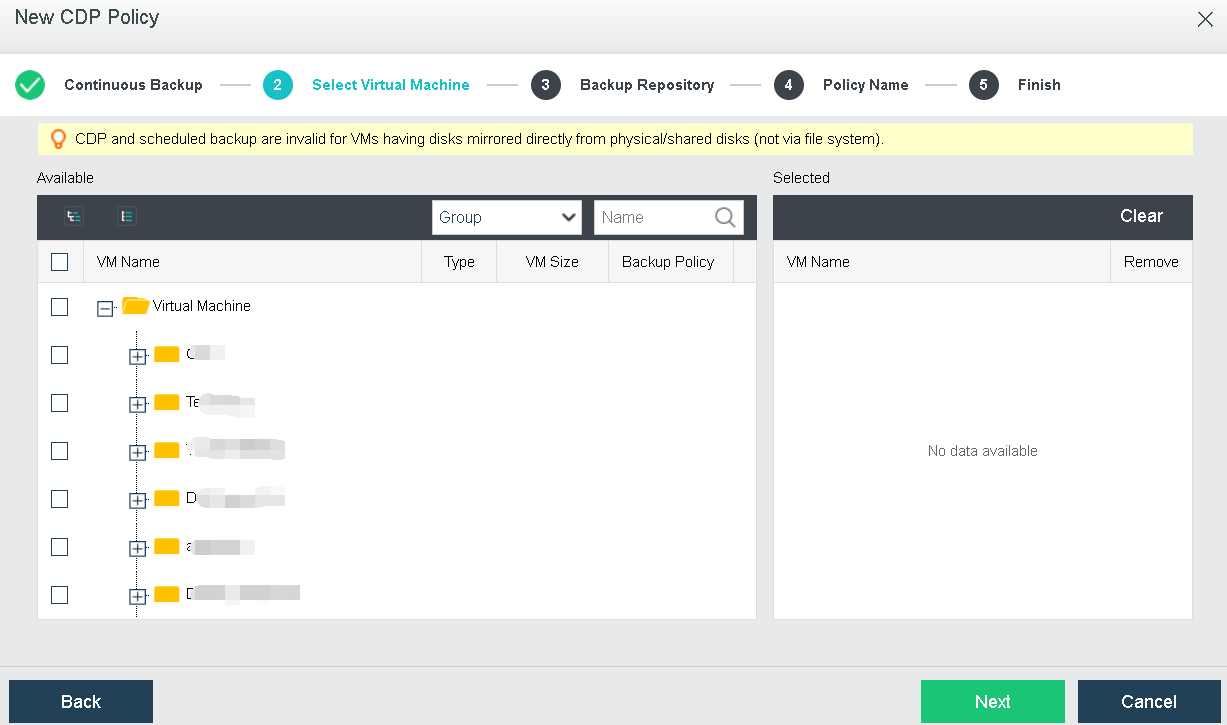
Clear: To clear the selected virtual machines, click Clear.
To remove a virtual machine from Selected list, click
CDP or scheduled backup is not applicable to virtual machines having disks mapped directly from physical or shared disks, rather than via file system.
One virtual machine cannot be associated with more than one backup policy. If the
virtual machine is associated with a new policy, it will be removed from the previous policy.
Template and virtual machines deployed from template do not support CDP.
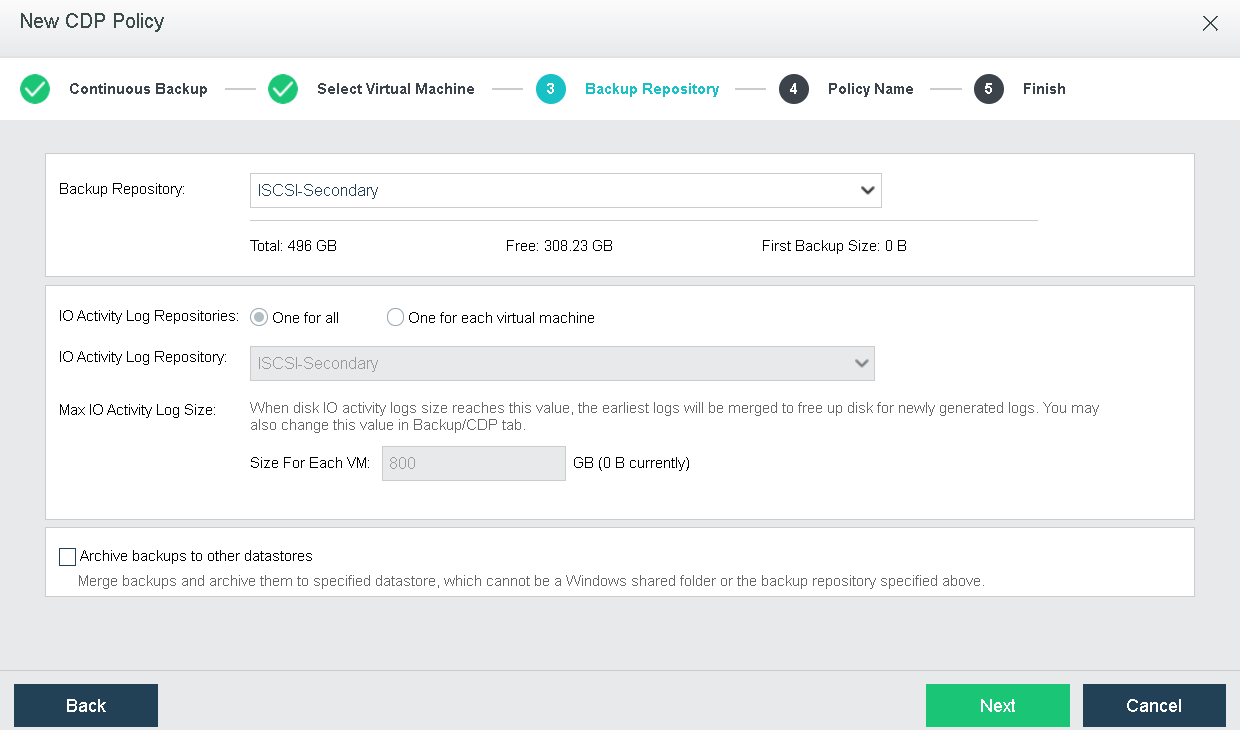
Backup Repository: It specifies backup repository, you may select an existing datastore or choose to add a new Windows shared folder. Once backup repository is specified, total capacity, available backup repository size and first backup size of the selected datastore will be displayed.
IO Activity Log Repositories: There are two options: One for all, One for each virtual machine, which enables you to specify a same IO activity log repository for all the virtual machines at a time or specify different IO activity log repository for each virtual machine, as shown below: 
IO Activity Log Repository: The repository should be a datastore that node(s) where the selected virtual machine(s) reside has access to. The default IO activity log repository is same with backup repository.
Max Log Size: When disk IO activity logs size reaches this value, the earliest logs will be deleted to free up disk for newly generated logs. You may also change this value in Backup/CDP tab. Max log size should be between 100GB and 10240GB, and should not be greater than the free space of the specified IO activity log repository
If IO read and write speed is lower than 50MB/s, CDP service may stop due to low storage performance. Therefore, datastore with better performance is recommended.
On this tab, you may fill in basic information for the new CDP policy such as policy name and description. 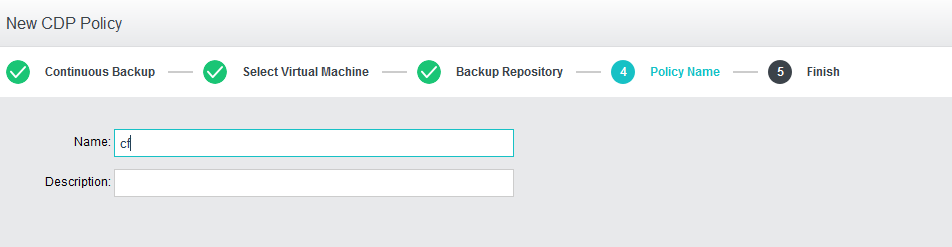
Name: Specifies name of the new backup policy.
Description: Specifies description of the new backup policy.
It displays the basic settings of the new CDP policy, such as Name, Backup Retention Period, Backup Repository and First Backup Size, IO Activity Logs Retention Period, IO Activity Log Repository and Max Log Space, as shown below:
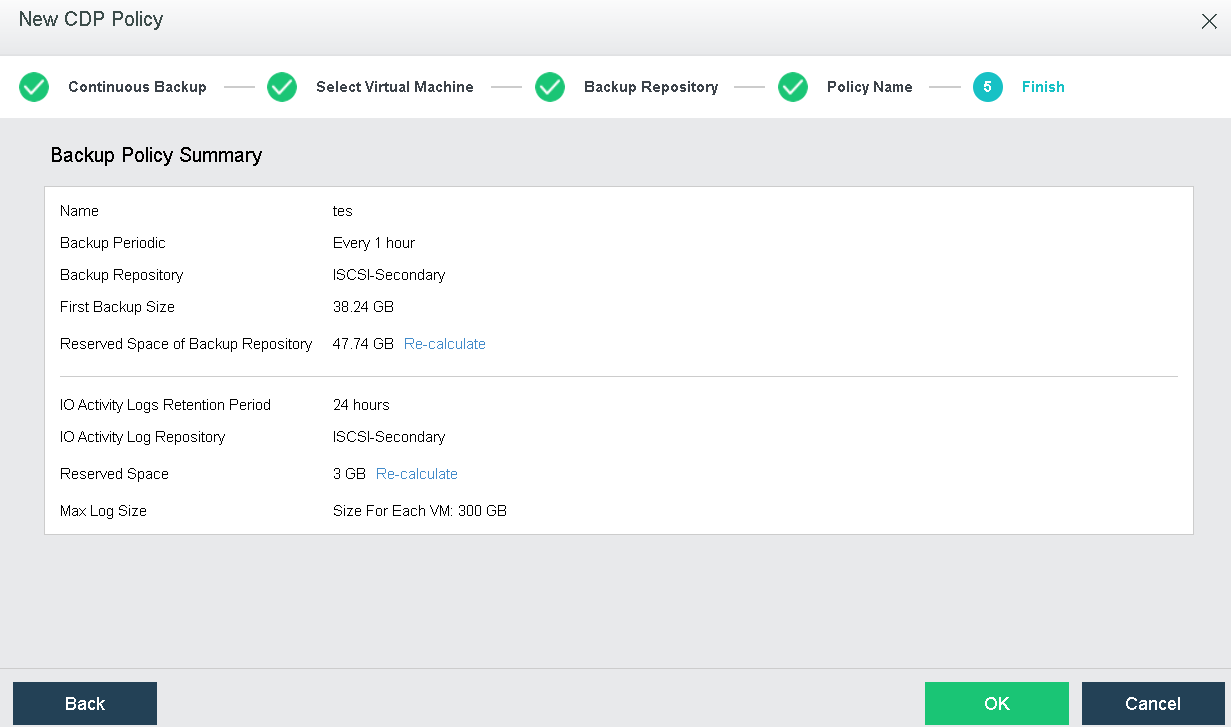
CDP can be started only for the virtual machine which is powered on and associated with a CDP policy. Template and virtual machines deployed from template do not support CDP.


 {{ $t('index.defaultHeader.chromeBrowserTip') }}