


{{ secondMenu.name }}




It is a logical interface formed by binding multiple Ethernet physical interfaces, providing more bandwidth, higher link reliability, link load sharing, and other advantages. To create a new aggregate interface, click Add on the Network > Interfaces > Aggregate Interface page, as shown in the following figure.
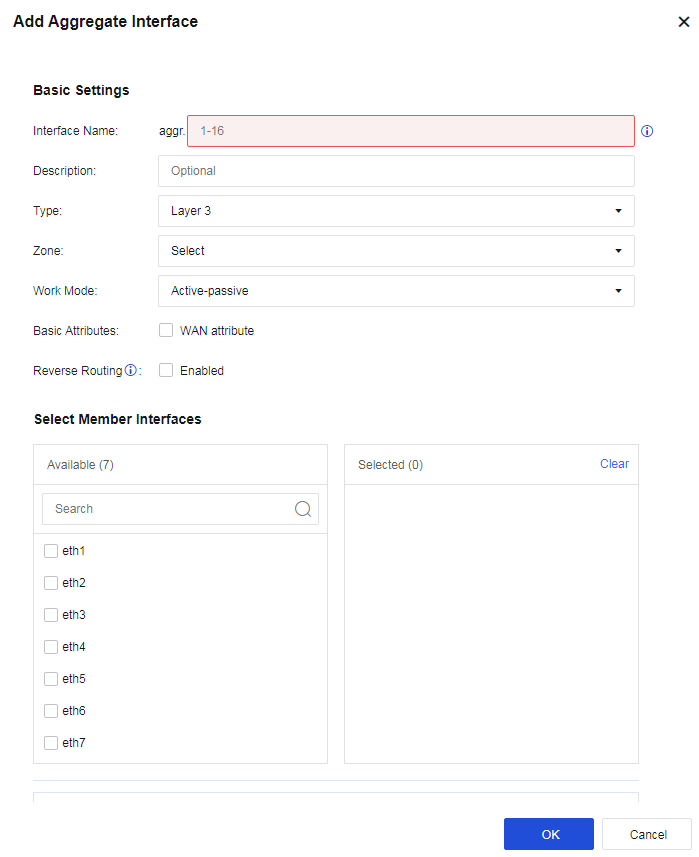
Name: Fill in the serial number of the aggregate interface. Only No. 1-16 can be filled in, i.e., up to 16 aggregate interfaces are supported.
Description: Briefly describe the interface.
Type: Configure the interface mode. It determines the data forwarding function of a device. There are three types.
• Layer 3: If the interface is selected to serve as a routing interface, it indicates that it works in Layer 3 mode, and an IP address must be configured. The interface has the function of routing and forwarding.
• Layer 2: The layer 2 interface is an ordinary exchange interface that neither requires the IP address nor supports routing and forwarding. It forwards data based on the MAC address table.
• Virtual Wire: The virtual wire interface is also an ordinary exchange interface that neither requires the IP address nor supports routing and forwarding. It forwards data directly through the paired interface of the virtual cable.
Work Mode: The working mode the aggregate interface supports, including Load balancing-hash, Load balancing-RR, Active-passive, and LACP.
• Load balancing-hash: Allocates data packets evenly according to the hash value of the source and destination IP addresses/MAC addresses of data packets.
• Load balancing-RR: Directly allocate data packets to each interface round-robin.
• Active-passive: Takes the interface with the largest eth number as the active interface to send and receive packets and the rest as the passive-interface (s) (for example, if eth2 and eth1 are selected, eth2 will serve as the active interface and eth1 will be the passive one).
• LACP: Standard LACP protocol docking. After selecting the LACP option, three hash strategies are available based on:

The aggregate interface does not support Mirror mode.


 {{ $t('index.defaultHeader.chromeBrowserTip') }}