


{{ secondMenu.name }}




It shows the security status from the aspect of business assets. You can check whether the business assets have intrusion risks or view the potential risks, as shown below.
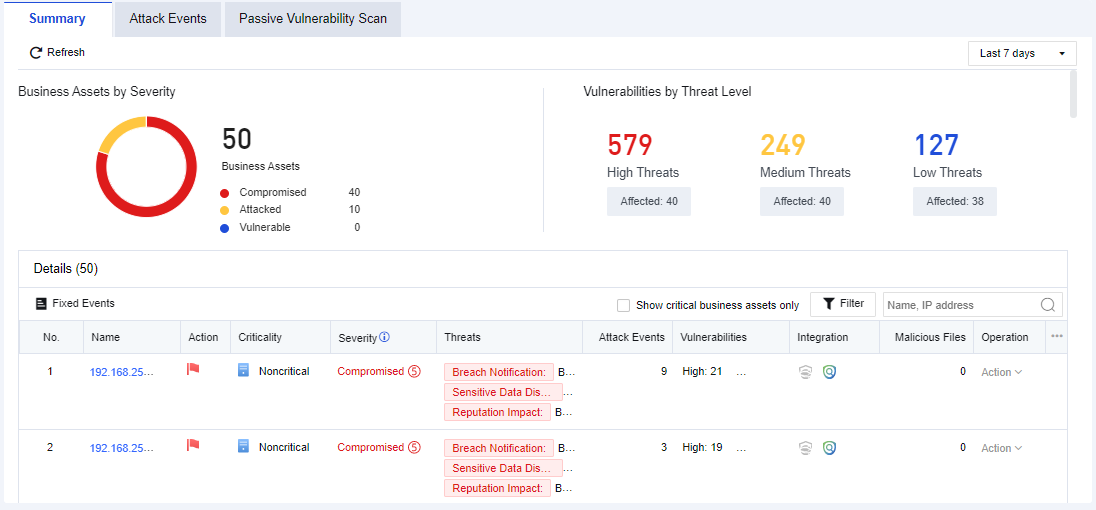
The description of risk levels is shown in the following table.
| Risk Level |
Note |
| Compromised |
Existing data prove that the server has been hacked, such as embedment of web shell, backlink, etc. |
| Attacked |
There is no data to prove that the server is hacked, but it will save the evidence of an attack, including SQL injection, brute-force attack, web shell uploading, and other attack logs. |
| Data harvested |
There is no data to prove that the server is hacked, but the evidence of collecting information will be recorded. |
| Vulnerable |
There is no data to prove that the server is hacked, and there is no attack history, indicating the server has reconnaissance. |
Table 6:Description of risk levels
Key risks include compliance notification, sensitive data disclosure, reputation impact, and high/medium/low vulnerabilities. Vulnerability statistics are based on the real-time vulnerability analysis results.
You can only view the security status of core business assets by selecting Show Critical Business Assets. See the figure below.
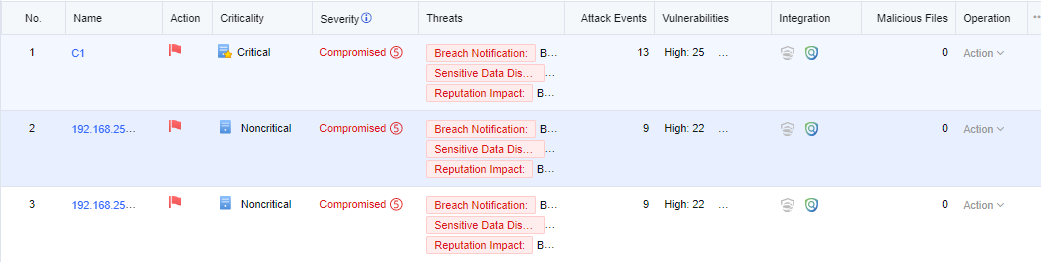
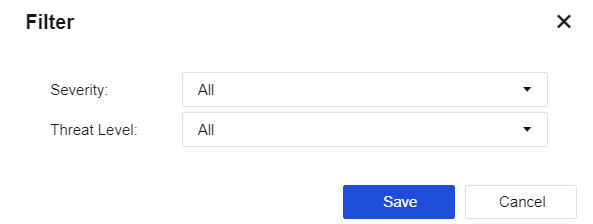
Click Filter. You can filter business assets by the Severity and Threat Level. See the figure below.
Click a business asset name. The following security details page will be displayed.
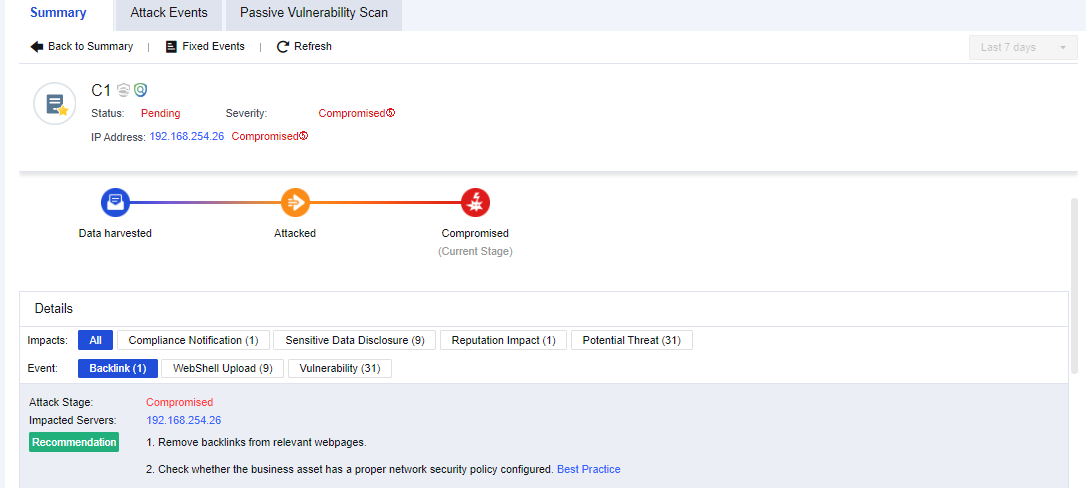
As shown in the above figure, the upper part is the summary of the business asset risks. Details include the current impacts on the business assets and the specific event types bringing such impacts (Webshell file access, Webshell backdoor, botnet, internal vulnerabilities, external attacks, etc.).
The risk level is Compromised. You can also see the impacted servers, recommendations, and proof.


 {{ $t('index.defaultHeader.chromeBrowserTip') }}