


{{ secondMenu.name }}




Click the interface named eth1 to open the configuration page, as shown in the following figure.

Status: To enable or disable the interface.
Type: Configure the interface mode. It determines the data forwarding function of a device. There are four types:
• Layer 3(Routing): If the interface is selected to serve as a routing interface, it indicates that it works in Layer 3 mode, and an IP address must be configured. The interface has the function of routing and forwarding.
• Layer 2(Transparent): The transparent interface serves as an ordinary exchange interface, neither requiring the IP address nor supporting routing and forwarding. It forwards data based on the MAC address table.
• Virtual Wire: The virtual wire interface is also an ordinary exchange interface that neither requires the IP address nor supports routing and forwarding. It forwards data directly through the paired interface of the virtual cable.
• Mirror: The mirror interface connects to a switch with the mirroring function to mirror the data flowing through the switch.
Basic Attributes: Set the interface's basic attributes and decide whether it is a WAN interface.
Reverse Routing: Specify whether data packets are sent out through the same link they come in. You need to enable this option when there are WAN links of multiple ISPs; otherwise, the service may be inaccessible. This option is automatically enabled once the WAN attribute is selected.
Obtaining an IPv4 address:
Selecting Static IP means that the interface's IPv4 address and next-hop IP address are specified by manual configuration. To configure routing on the interface, you need to configure a corresponding IP address.
If you're setting up a dual-device active-standby, please add -HA to the IP/netmask for the out-of-sync IP addresses.
You must fill in the Next-Hop IP field if the WAN box is checked. The default route will not be generated automatically after the Next-Hop IP has been filled up.
Selecting DHCP means that the IPv4 IP address and next-hop IP address are automatically obtained using DHCP.
Selecting PPPoE to obtain an IP address by dialing. As ISPs' IP addresses are changed frequently, adding default route(s) is required.
Obtaining an IPv6 address:
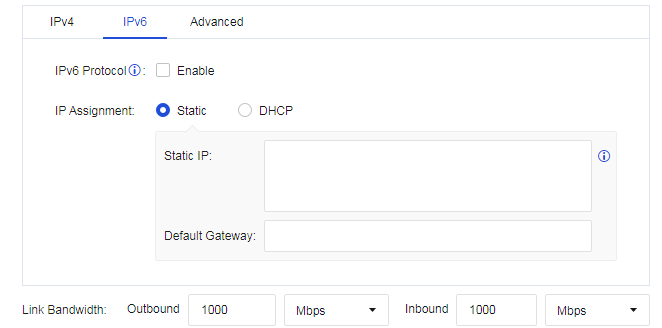
Select Static IP means that the interface's IPv6 address and next-hop IP address are specified by manual configuration.
Selecting DHCP means that the IPv6 IP address and next-hop IP address are automatically obtained using DHCP.
Advanced: You can set the interface's link mode, MTU, and MAC address. You can also enable the jumbo frame to support 9,000-byte MTU, as shown in the following figure.
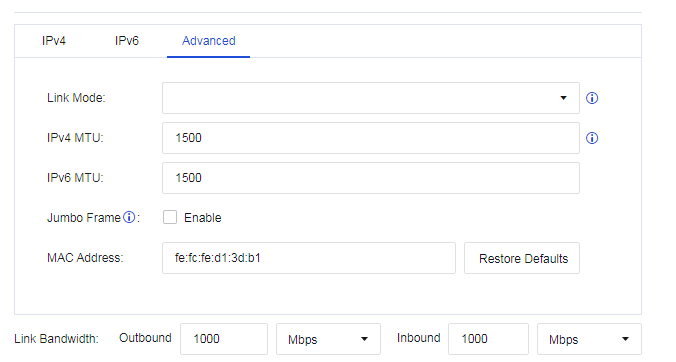
• Link Bandwidth: Set the line bandwidth range of the interface, as shown in the following figure.

• Management Service: Set whether to allow the interface to access devices, such as HTTPS, PING, SSH, and SNMP.


1. Management interface ETH0 is a routing interface whose interface mode cannot be changed.
2. Users can add management IP addresses to ETH0. However, the default management IP address 10.251.251.251/24 cannot be deleted. For NGAF8.0.23 or higher versions, implement changes under System > General Settings > Network.
3. The IPv4 address of any interface must not lie in the 1.1.1.0/24 segment.
4. You cannot simultaneously activate the preemption function in dual-device active-standby mode and link detection.


 {{ $t('index.defaultHeader.chromeBrowserTip') }}