


{{ secondMenu.name }}
 {{ language }}





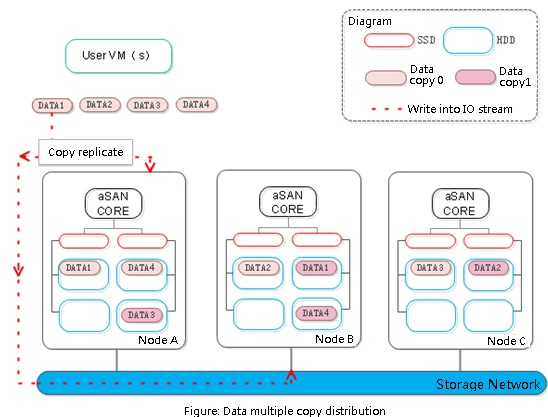
Multi-copy means the redundancy technology which saves multiple copies of the data; the consistency of copies and the synchronization of copies are guaranteed by the copy duplication module of aSAN. Copies under bottom management are transparent to the upper layer service; and the upper layer does not sense the existence of copies.
aSAN supports dual copies and triple copies; the copy storage position must comply with the host mutual exclusion principle, i.e., two copies cannot exist on the same host at the same time.
Taking dual copies as example:
• When writing a piece of data, the data will be sequentially stripped and fragmented; then, it will be respectively written into different hosts by the copy duplication module. In case that there is no failure, the data writing can be regarded as successful after the writing of the two data copies is completed, in order to guarantee the consistency of the duplicated data.
• When reading a piece of data, any of the copies will be selected for reading. In case that there is no failure like network disconnection and hard disk failure, the data copies are always consistent, and there is no difference between the so called primary copy and secondary copy.
As shown in the figure below, every DATA has two copies on two hosts.
Although the copy mechanism brings in the high reliability, it actually reduces the actual available capacity of the storage volume. The calculating formula for storage volume available capacity is as follows:
Storage pool available space = (cluster data disk gross space - data disk gross reserved space) / copy number. In general, the reserved space of each data disk is 16G.
For example: the storage volume is set to dual copy redundancy pattern which consists of 4 physical hosts, each node is provided with six 1TB hard dives as data disks (it should be specially noted that, the 1TB hard drive of the manufacture is equal to 1000GB, but it shall be converted into 1024 system; therefore, the actual capacity identified in the system is about 931GB), the actual available space of storage volume = (4*6*(931GB-16GB))/2=11052GB, i.e., 11052/1024=10.8TB.


 {{ $t('index.defaultHeader.chromeBrowserTip') }}